Jacob Shore
Job Tracker AI
A local-first, cost-aware job search pipeline. Structured orchestration and selective LLM evaluation — cheap work done cheaply, expensive work done sparingly.
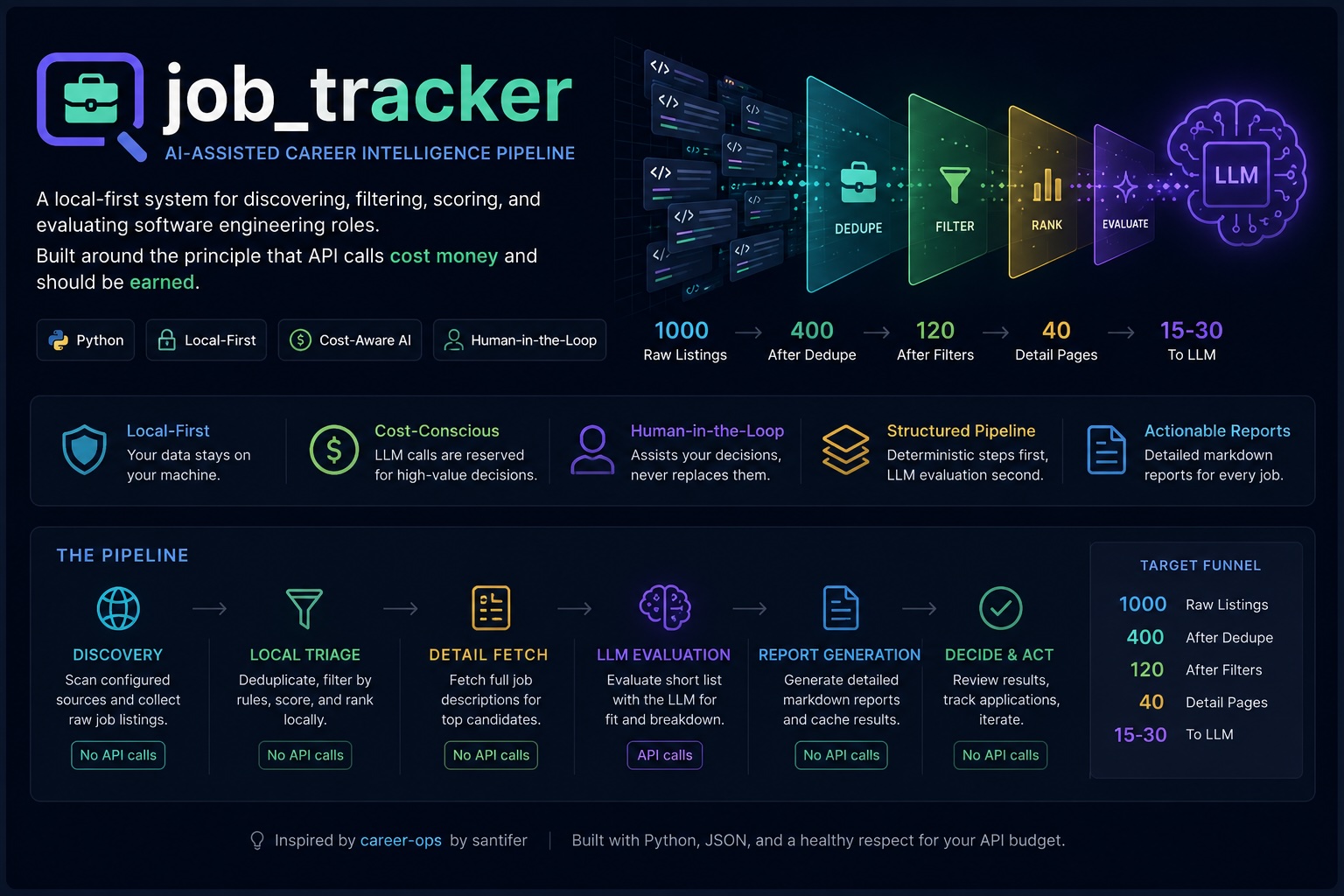
A local-first CLI pipeline that turns a noisy job market into a ranked, LLM-scored shortlist — without burning API budget on roles you’d never take.
The Problem
Job boards surface hundreds of listings with overlapping titles, inconsistent seniority signals, irrelevant stacks, and compensation that varies 3× by location and remote policy. Manual triage is slow. Sending every description straight to an LLM is expensive and doesn’t solve the signal problem.
How It Works
The pipeline does the cheap work cheaply and the expensive work sparingly:
- Ingest — pull listings from ATS APIs (Greenhouse, Lever, Workable, Ashby) and Brave Search
- Hard filter — eliminate on title keywords and avoid terms; zero API calls
- Rule score — weighted scoring across role fit, seniority, location, stack, and compensation using YAML-defined criteria
- Semantic score — optional local embedding similarity via
all-MiniLM-L6-v2; no API call - Quick LLM eval — only the top-N survivors go to the model for a structured fit score, summary, strengths, and red flags; results cached by input hash
- Report generation — detailed markdown reports for high-confidence listings; skips listings that already have a report
- Application materials —
job applygenerates a tailored CV and cover letter, renders them to HTML templates, and exports PDFs via Playwright
Every stage writes structured output. The CSV is the persistent state store.
What Makes It Different
LLM calls are earned. A listing that reaches the model has already passed a hard filter, a keyword scoring pass, and a configurable score threshold. The model sees a curated shortlist, not raw feed volume.
Cost is a first-class concern. Model selection, token budgets, concurrency, and how many listings reach each stage are all externalised to a YAML config. Cheaper models handle high-volume stages; better models handle report generation.
Local-first data ownership. The CV, profile, listings data, LLM responses, and generated reports live on disk. Nothing is sent to an external service except the LLM API call itself.
Human-in-the-loop, not autopilot. The pipeline produces ranked listings and fit reports. Apply/skip decisions remain with the operator.
Determinism before probability. Scoring uses explicit, auditable YAML rules — role archetypes, keyword lists, score ladders, weighted dimensions. You can read why a listing scored the way it did and adjust the knobs without guessing.
Tech Stack
- Python with Click CLI, Jinja2 prompt templates, concurrent thread pools
- OpenAI / Anthropic — provider-agnostic
LLMClientinterface; switch per stage via config - Local semantic scoring —
sentence-transformerswithall-MiniLM-L6-v2 - PDF generation — Playwright CDP to system Chrome (the only reliable way to suppress Chrome’s date/title overlay in headless mode)
- Storage — URL-keyed CSV with upsert semantics; hash-keyed LLM response cache
Quickstart
job generate-criteria   # derive scoring rules from your CV + profile
job pipeline            # scan → score → evaluate → report
job apply               # pick a listing and generate tailored application materials